

Struggling with jacket sleeves?
A short cape may be the easier answer, as it rests on your shoulders without making you work your arms through sleeves. And it’s one of several adaptive clothing options for people who can’t raise their arms easily, alongside easy-dressing designs and open-back styles.
If a stiff shoulder or a weaker side has made getting dressed the slowest part of your morning, you know this moment well. Your first arm slides into your jacket without much fuss. The second one gets stuck somewhere behind you, halfway into a sleeve you can’t see. Then you have to choose between pushing through the pain and calling for help (neither feels great before breakfast).
When you’re the one helping, getting an arm into the sleeve isn’t your only concern. You guide a parent’s or partner’s arm into a shirt sleeve while watching their face for any sign that it hurts. Then it’s time for the coat, and you have to do the whole thing again.
Kayden Design, an adaptive clothing company in Parksville, BC, builds its clothes around mornings like these. Its short capes offer an extra layer without another set of sleeves to manage.
Short capes make the outer layer easier to manage, but what about the clothes underneath? Here’s what you should know about dressing with limited arm movement.
Why does limited arm movement make getting dressed more difficult?
Limited arm movement makes dressing harder because most clothes assume your arms can rise overhead and reach behind your back. And 4 movements cause most of the trouble.
- A pullover needs both arms lifted above your head.
- A coat makes you reach behind your back for the second sleeve (often the hardest part).
- A fitted sleeve forces your arm to turn outward as it slides down.
- A buttoned shirt needs both hands working together at your chest.
Different conditions block different movements. A frozen shoulder stiffens until the arm won’t lift or turn, and a stroke can weaken one whole side. Arthritis or surgery can jam the same joint for weeks or even years.
Once a movement is off the table, your body starts to compensate. You lean and twist to make up the difference, which tires you out and makes every layer slower than the one before.
You’re far from alone in this. Statistics Canada counted 3.2 million Canadians aged 15 and over (10.9%) with a flexibility disability in 2022, a category that includes trouble reaching above your head, and the rate climbs to 23.7% among people 65 and older.
Those limitations don’t disappear when it’s time to get dressed. But clothes that require less lifting, reaching, and twisting can make the process easier, even when your range of motion hasn’t changed.
What types of clothing are easier to wear without raising your arms?
The easiest clothes open wide enough that the garment can wrap around you, instead of your arms climbing up into it. Here are five types, starting with the one that asks the least of you.
| Clothing type | How it goes on | What your arms do | Who it suits |
| Short cape | Settles on your shoulders and closes at the front | Nothing goes overhead and no sleeve needs threading | Stiff shoulders, wheelchair users, an arm in a sling |
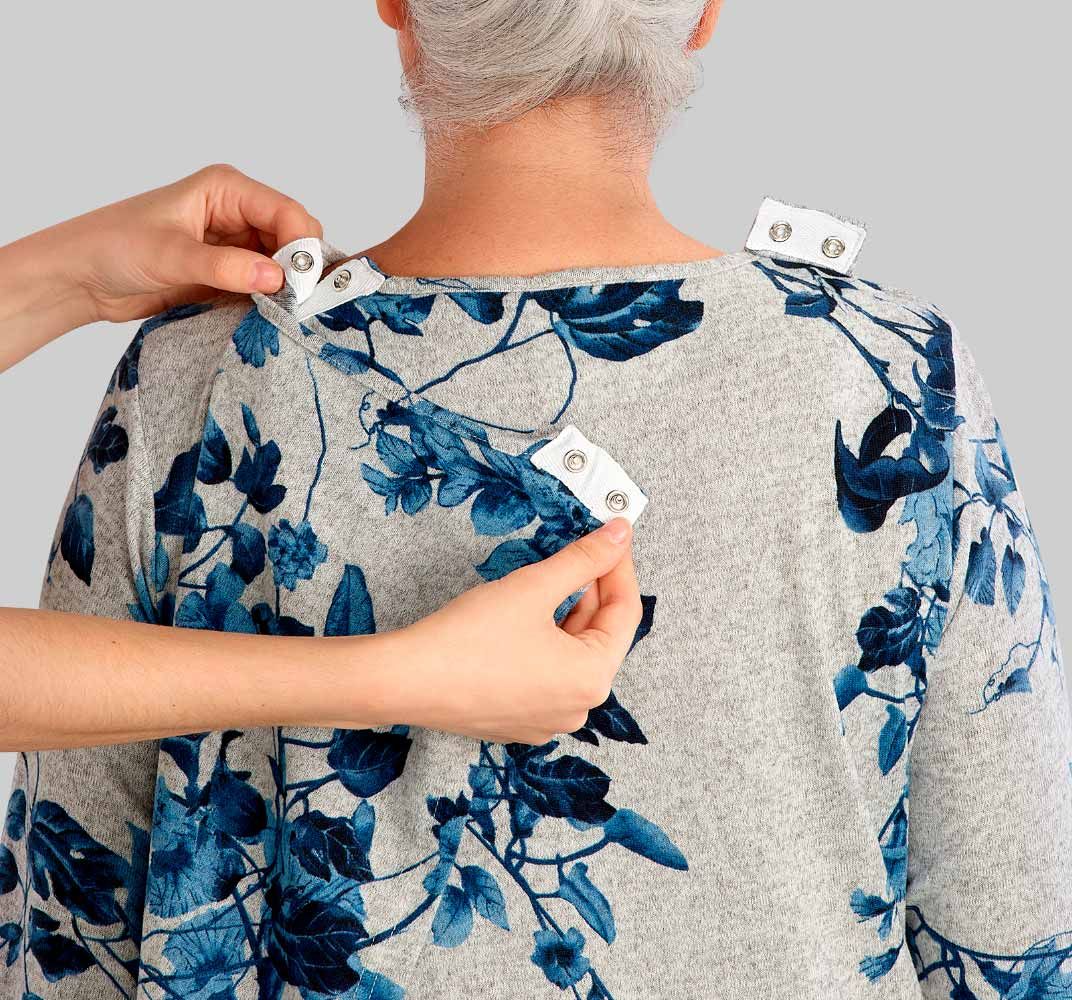
| Open-back top | Sleeves go on from the front, then the back closes | Arms stay low while a helper closes the back | Anyone who gets help dressing every day |
| Side-opening top | One side opens so the top wraps around you | Little lifting, but the side needs closing | A sling, a cast or recent surgery |
| Front-opening shirt or cardigan | One sleeve at a time, then buttons or a zip | One arm reaches back for the second sleeve | One stiff shoulder (dress that side first) |
| Poncho | Pulls down over your head | One arm or a helper lifts it overhead | Wet days, if one arm moves freely |
Kayden’s short capes accessories and its open-back tops for men and women fill the first two rows. Between them, one shop covers the inner layer and the outer one.
Shops also sell the same cut as a capelet or a shoulder cape. The name matters less than the opening, because a style that pulls on over your head behaves like a poncho, whatever the tag says.
Dressing sticks and reachers can help with sleeves too (a stick’s hook pulls a collar or sleeve into place), and an occupational therapist can show you how to use them. A tool still leaves the sleeve in your way, though, and a cape removes it entirely.
How do short capes make dressing easier for people with limited arm mobility?
Short capes make dressing easier because there are no sleeves to thread, so a stiff or weaker arm doesn’t have to be guided through one. If one arm moves more easily than the other, you may be able to put on a front-opening cape while seated:
- Sit in a steady chair so you can handle the cape without standing.
- Open the front fastening and hold the cape by its collar with your stronger hand. Place one side over your weaker shoulder.
- Bring the remaining fabric around your back and over your other shoulder, as far as you can comfortably reach. Ask for help if the movement is difficult.
- Bring the front edges together and close the fastening near your neck, or ask someone to help if you can’t reach it.
Once it’s on, a short cape keeps your neck and shoulders warm without tight sleeves, armholes that pinch, or cuffs that drag as you move. A well-fitting cape can also leave your hands free to hold a mug or propel your wheelchair, provided the fabric stays clear of the wheels.
If you can’t comfortably manage the reach in step three, a helper can settle the cape over both shoulders while you keep your arms relaxed. They can also adjust the fabric at the back and close the front fastening if you need help with that part. After surgery or a stroke, a cape may make dressing easier, but your care team’s instructions about movement and sling use still come first.
Short capes or traditional jackets: which is more convenient for restricted arm movement?
When arm movement is restricted, a short cape may be easier to put on for indoor wear or quick trips outside. A weatherproof jacket still offers better coverage in rain and strong wind. Here’s how they compare when you’re getting dressed, wearing a sling, or heading outside.
| Dressing step or feature | Short cape | Traditional jacket |
| First arm | No sleeve, so nothing to thread | The weaker arm usually goes into its sleeve first |
| Second arm | No second sleeve | The other arm still needs to go through a sleeve |
| Settling it on | Drapes over your shoulders | Fabric is pulled into position, sometimes with help |
| Closing it | Often one front fastening, depending on the design | A zip or a row of buttons |
| Over a sling | May drape over the sling, depending on fit | May need a roomier fit or an alternative way of wearing it |
| Rain and wind | Many short capes leave the arms exposed and offer limited protection from rain or wind | A weatherproof jacket covers the arms and protects against rain and wind |
| Taking it off | Open the front fastening and lift it away | Both arms come out of the sleeves, usually the stronger arm first |
With a jacket, even the order of the sleeves matters. Thompson Rivers University’s guide for health care assistants recommends putting the weaker arm into a sleeved garment first and taking the stronger arm out first when undressing. A short cape skips that sleeve-by-sleeve process, which can make dressing easier when one arm is in a sling. For someone helping with dressing, having fewer sleeves to manage may also make the process easier, as Kayden’s caregiver comparison explains.
But ease of dressing isn’t the only consideration on Vancouver Island, where even a short walk to the car can mean getting caught in the rain. A weatherproof jacket offers more coverage in those conditions.
On dry days, some people avoid putting their restricted arm through a sleeve by wearing the jacket over their other arm and draping the loose side over their shoulder. This avoids having to thread the restricted arm through a sleeve, although the loose side may shift and leave the arm exposed.
If you’re recovering from surgery, check with your care team before trying this or another way of wearing a jacket.
What should you look for when choosing a short cape for limited arm movement?
Look for a short cape that’s easy to put on, whether you dress yourself or need some help, and stays in place when you sit. Let’s look at each factor in detail:
Cape length
If you use a wheelchair, cape length affects how much fabric rests in your lap or bunches near the wheels. Kayden Design offers both short and long capes.
- Kayden’s short cape sits higher than its long cape, so there’s less fabric to catch in wheelchair wheels or bunches at your waist.
- The long cape covers your lap too, but its back is cut shorter to reduce bunching when you’re seated.
- The short cape costs $45.00 and the long cape $55.00.
Front opening
When lifting an arm hurts, the first thing to check is how the cape opens.
- Check that the cape opens all the way down the front, so you don’t have to pull it over your head.
- Choose a closure you can manage with your stronger hand, or one a caregiver can fasten without pulling at your sore arm.
- Check that the closure stays fastened when you lean forward or reach for something.
Fabric weight and feel
If your shoulder is sore, a heavy cape may pull uncomfortably as you move, so pay attention to both its weight and how it sits.
- Kayden’s short cape is made from 100% polyester polar fleece, and its product listing gives a weight of 300 grams.
- The same fleece forms a high collar that warms your neck without a scarf to wind around it. If you wear the cape for hours, check that the collar doesn’t rub against your chin.
Wash care
A cape you wear every day will need regular washing, so check how the fabric holds up and whether it can go in the dryer.
- Kayden recommends warm-water washing and a warm dryer for its short cape, and the product listing says the fabric won’t shrink.
- Kayden also designs its clothing with care-facility washing in mind, which can be useful if a care home handles your laundry.
Once the cape arrives, give it a seated test. Sit in the chair you use most and rest your affected arm comfortably in your lap. Try putting the cape on and fastening it with your stronger hand, if you can. Then reach for something you normally use without straining your arm. Check that it stays on both shoulders without pulling across your sore side or bunching behind your back. If you use a wheelchair, make sure the fabric stays clear of the wheels. If it passes those checks, that’s a good sign it will work for everyday wear.
When should you consider custom adaptive clothing for restricted arm movement?
Consider custom adaptive clothing when ready-made pieces solve part of the problem but not all of it. You might need something more specific if:
- A short cape keeps you warm, but the shirt underneath still fights you every morning.
- You need an opening in a specific place to accommodate a sling or medical device.
- Someone helps you dress every day, and your current clothes make the job harder for both of you.
- Your arm movement may stay limited for months or years, making a short-term clothing workaround less practical.
Frozen shoulder is one condition that can turn an everyday dressing problem into a long-term one. Alberta’s provincial health site, MyHealth Alberta, says frozen shoulders can take a year or more to get better, and that avoiding movement can make the shoulder stiffer. A year is a long time to dress around a joint you’re also trying to keep active.
It’s also a long time to leave a favourite shirt hanging in the closet simply because you can no longer put it on comfortably. If you still love how that shirt looks and feels, having it adapted may make more sense than giving it up.
Kayden Design offers alterations for clothes you already own, as well as custom-made pieces for needs those clothes can’t meet. If you live near Parksville, you can bring in good-quality clothes you already own, and the team will adapt them for easier dressing. For customers farther away, Kayden takes custom enquiries by phone or email.
Measurements and simple drawings can help explain what you need, and the team makes its bespoke pieces in-house on Vancouver Island. If you have notes from an occupational therapist, you can share those too, especially if they explain which arm movements are difficult or painful.
Explore short capes and adaptive clothing solutions at Kayden Design!
Kayden Design sells short capes online and has a storefront in Parksville for anyone who’d rather discuss fit or adaptations in person.
- Order the short cape online in sizes S to XXL and six colour options. The company aims to ship orders within three days of receiving them.
- Visit the shop at 125 McCarter Street, Unit 5, Parksville, Tuesday to Friday from 10 a.m. to 4 p.m. or Saturday from 10 a.m. to 2 p.m.
- Call (250) 927-6529 or email info@kaydendesign.com to talk through an adaptation or a custom order.
Sleeves don’t have to decide how your mornings go. Explore a short cape, or ask Kayden’s team about adapting a favourite garment that’s become difficult to wear.
Frequently asked questions (FAQs)
Q1. How do you get dressed with a frozen shoulder?
Sit down and guide your stiff arm into the sleeve first, then use your other arm to help pull the clothing into place without forcing a painful movement. Reaching for clothes can be difficult, too, so keep the ones you wear most between waist and shoulder height. Front-opening tops are often easier to manage than pullovers, while a short cape lets you skip coat sleeves altogether.
Q2. How do you dress someone who can’t lift their arms?
Bring the sleeve to the arm instead of lifting the arm to the sleeve. Gather the sleeve in your hand and ease it over their arm, keeping the arm supported as you go. Don’t tug on their arm, especially if the shoulder is painful, stiff, or weak. Follow any movement restrictions from their care team. Let them do whatever steps they can, so the morning still feels like theirs.
Q3. What is the easiest jacket to put on if you can’t lift your arms?
A loose, front-opening jacket with roomy armholes is often easier to put on. A smooth lining helps it glide over a sweater, while a zip with a large pull is easier to manage than small buttons if gripping is difficult. If the sleeves are still the hardest part, a short cape avoids them altogether.
Q4. How do you adapt regular clothes for limited mobility?
Swap small buttons for snaps or Velcro-style fasteners, and add a ring to a zip pull so it’s easier to grip. Bigger changes, like opening the back of a shirt, need a sewing pro. For more involved alterations, local customers can bring good-quality clothing to Kayden Design’s Parksville shop.



