

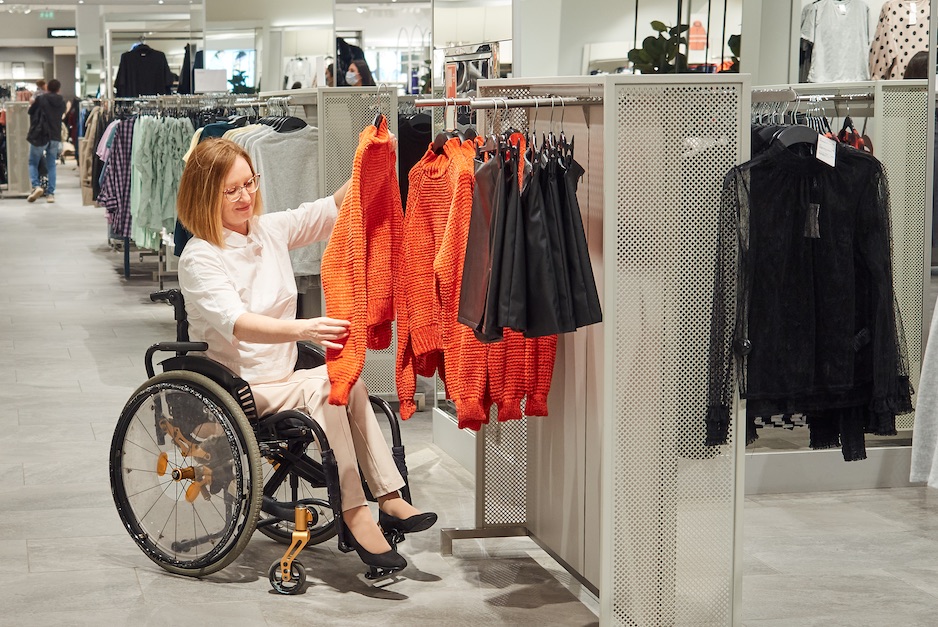
Why does getting dressed feel like a workout?
Many tops go on over the head, which means lifting both arms high and twisting your shoulders before you’ve had breakfast. The problem isn’t always getting dressed. Sometimes, it’s the clothes.
If that sounds like your mornings, you’re not the only one. According to Arthritis Society Canada, arthritis affects about 1 in 4 people assigned female at birth in Canada, and more than 40% of people with arthritis live with pain bad enough to limit their daily activities. A stroke or a shoulder that’s still healing after surgery can make those same arm movements difficult, too.
Even deciding what to wear can become a compromise. Many women swap their favourite blouses for whatever stretched-out shirt goes on without a struggle, and they stop dressing like themselves.
That’s where open-back adaptive tops can make a difference. These tops offer another way to get dressed: the sleeves can slide on from the front while you stay seated and keep your arms low. Kayden Design, a Canadian company in Parksville on Vancouver Island, makes its open-back ladieswear tops to make dressing easier without asking women to give up their personal style. The back openings also let family members and care aides help without having to pull a top over the wearer’s head.
And picking the right top depends on where and how you get dressed, whether someone helps you, and which styles you feel comfortable wearing.
- Why adaptive tops can make dressing easier
- How open-back designs work when seated, lying in bed, or dressing with assistance
- Kayden’s two collections, with prices from $55 to $81
- What to check before ordering in Canada, including custom options
What makes adaptive tops a practical clothing choice for women with limited mobility?
Open-back adaptive tops are practical because they take the overhead lift out of getting dressed. Your arms can slide into the sleeves from the front, and the back panels fasten behind you, with help if needed.
For someone with limited flexibility, even reaching overhead can be difficult. Statistics Canada counted 3.2 million Canadians aged 15 and older with a flexibility disability in 2022. That includes difficulty bending down or reaching in any direction, including above the head, when it limits daily activities.
Women+ were more likely than men+ to have one (11.8% vs. 9.9%), and the rate was 23.7% among people aged 65 and older. For women who struggle to raise their arms, a pullover can make the shirt itself the obstacle.
Here’s how a pullover and an open-back top compare when it’s time to get dressed.
| Feature | Conventional pullover | Open-back adaptive top |
| Getting it on | Usually pulled over your head | Sleeves guided on from the front with your arms low |
| Your position | Often easier to put on while sitting or standing upright | Can be put on while seated; some styles also work while reclined or lying down |
| Fastening | Usually no fasteners | Back panels secured with snaps or other closures |
| Helper’s effort | May involve guiding the top over the head and shoulders | Guiding the sleeves on and securing the back panels |
Front-opening shirts with Velcro or magnets can make fastening easier when your fingers are stiff, but they don’t always help with shoulder movement. Getting the second sleeve on may still hurt if you have a frozen or arthritic shoulder.
Comfort isn’t the only thing women consider when choosing a top. Some keep wearing a pullover that hurts because it’s the one that still looks like them.
Why should women have to choose between looking good and getting dressed comfortably?
An open back keeps the adaptive part behind you, so the front can still look like the blouse you’d have picked anyway.
How do open-back tops accommodate different dressing situations?
Open-back tops can make dressing easier whether you’re seated, lying in bed, getting help from someone else, or recovering from surgery. With the sleeves going on from the front and the fastenings at the back, there’s less need to lift your arms or pull fabric over your head.
Now, let’s take a look at the benefits of open-back tops.
Seated dressing
In a wheelchair or armchair, an open-back top can go on without you standing up. Once fastened, the back panels should lie flat against your back so they don’t bunch up between you and the chair through a long afternoon.
If someone helps you dress while seated, the process may look like this.
- Let your helper guide your arms into the sleeves from the front, keeping them as low as feels comfortable.
- If you can lean forward safely, do so a little to give your helper room behind you.
- Your helper brings the back panels together, fastens them, and checks that the fabric sits comfortably against your back.
In-bed dressing
When sitting up isn’t safe or possible, a family member or care aide may need to help you dress while you’re lying down. Getting the sleeves on is only part of the job here. Your helper also needs to arrange the back panels beneath you.
If you’re helping a woman dress in bed, how you arrange the panels depends on whether and how she can be safely repositioned.
- Help her into the sleeves while she remains in a comfortable, supported position.
- Follow her care team’s positioning instructions to access the back panels, getting another helper if needed.
- Smooth the panels into place and fasten them without pulling on her shoulders or disturbing any medical lines.
- Check that the fabric lies flat beneath her. Creases can press against her skin when she stays in bed for long periods.
If moving her into position is difficult, ask her home care nurse or occupational therapist to show you a safe way to dress her in bed.
Assisted dressing
If a family member or personal support worker helps you dress every day, an open-back top can make their part of the job easier, too. Depending on your mobility, your helper may not have to:
- Lift your arms above shoulder height to get the top on.
- Guide your head through a tight neckline.
- Manoeuvre a sore shoulder into the second sleeve.
Helping someone dress is only one part of caregiving, and the demands can add up. A 2024 Statistics Canada study found that 74% of unpaid caregivers looking after adults reported at least one negative effect on their health and well-being. Among sandwich caregivers, who also look after children, the figure reached 86%.
For someone who helps you get dressed morning after morning, avoiding awkward arm movements can make that daily task a little easier.
Post-surgery dressing
If your care team has told you to keep your arms low after surgery, an open-back top may make it easier to dress within those limits. The back opening lets you avoid pulling fabric over your head, which may help when shoulder or chest movement is restricted.
That same back access can also help during treatment and medical appointments. Kayden Design’s Classic ladieswear tops are intended for care routines such as these:
- During IV treatment, the top can be changed without pulling it over your head, with the care team’s help to protect the IV line.
- At physiotherapy, the back opening can give your therapist access to your back or shoulders without necessarily removing the whole top.
- At a medical exam, the back can open for examination while the front may remain covered, depending on what the exam requires.
Classic or Creative Collection: which adaptive tops should women consider?
Kayden Design offers two collections of open-back adaptive tops: Classic and Creative. Classic has a wider mix of everyday styles, priced from $55 to $81, while Creative focuses on more distinctive prints in the $55 to $64 range.
When families picture adaptive clothing, a pale gown that ties at the back may still come to mind. Kayden’s Classic range alone runs from a Kelly Green V-neck to Aqua Batik.
Beyond the colours and prints, families may want to check the available sizes and whether a favourite print can be reordered.
| Feature | Classic Collection | Creative Collection |
| Price range | $55 to $81 | $55 to $64 |
| Style mix | Solid V-necks, batiks, florals and two-tone colour blocks | Bold red florals, softer blue/green and yellow with black |
| Example styles | 1003 Marine Blue V Neck (65),AquaBatik(63), Red Multi Floral (69),BlackandGrey(81) | Red floral, blue/green and yellow-and-black prints |
| Fabric | Soft, breathable fabrics; check the individual style for composition | Woven cotton and polyester; check the individual style for composition |
| Sizes listed | Women’s size chart from XS to 3XL; availability varies by style | Small to extra large |
| Availability | Regularly stocked collection; Kayden replenishes the line | Limited fabric stock; some styles may not return |
| Suits you if you want | Familiar solids, a V-neck or a wider colour choice | A statement print or a limited-fabric design |
If you’re torn, start with the look you’ve always liked wearing because familiar clothes are the ones you’ll reach for every morning. A solid V-neck from the Classic Collection looks like a regular blouse at a family dinner. Bold florals suit the days you want more colour, while Classic’s Aqua Batik gives you another print to choose from.
If florals are your favourite, price may help you decide. Creative tops are listed at up to $64, while the Classic floral examples run from $65 to $69. If you find a Creative print you like, check whether it’s still available before ordering, since Kayden may not be able to restock the same fabric.
What should women consider before ordering adaptive tops in Canada?
Once you’ve chosen a style, check the fit, fastenings and care requirements before ordering online. You won’t know how the top actually feels until it arrives, so getting those details right now may save you the trouble of a return.
These 6 checks are worth making whether you’re buying for yourself or helping someone else order.
- Check your measurements. Match your bust measurement to Kayden’s ladieswear size chart, which runs from XS (32 to 33 inches) to 3XL (47 to 50 inches). Follow the chart’s measurement instructions, and call Kayden if you fall between sizes or aren’t sure how the top will fit while seated.
- Confirm the size is available. Kayden lists its Creative Collection tops from small to extra large, so make sure your chosen style comes in the size you need. The broader women’s size chart doesn’t mean every style comes in every size.
- Decide who’ll do the dressing. Open-back fastenings are usually easier for a helper to reach, so if you dress on your own, ask Kayden where the closure sits and how it works.
- Check the washing instructions. Kayden makes its clothing with facility washing in mind and uses roomy cuts to allow for some shrinkage. If you live in a care home, check the care label and mark each top with your name before it goes into the shared laundry.
- Think ahead to the cold months. If pulling on a sweater is difficult, a cape may be easier to wear over an open-back top because there’s no second set of sleeves to thread your arms through. Kayden also sells capes in its accessories range.
- Get clear on delivery before you pay. Kayden aims to ship orders within three days of receiving them, but that isn’t the same as a delivery date. Check the shipping cost to your province and confirm the return terms for your chosen top before paying.
When the top arrives, try it on while seated or in your usual dressing position, before washing it or removing the tags.
Check that the sleeves feel comfortable, the back panels lie flat, and nothing pulls when you move.
What are the options when standard adaptive tops do not meet individual needs?
When a standard adaptive top doesn’t fit your body or work with the way you move, Kayden Design offers two options: a custom garment made in-house on Vancouver Island or alterations to clothes you already own. A size chart can point you toward a size, but it can’t tell you how a top will sit on a curved spine or how easy it will be to put on with an arm weakened by a stroke.
- Custom design starts with a conversation about what makes dressing difficult for you. You or your caregiver can share measurements or drawings if they help explain your needs, but Kayden doesn’t always require them.
- Alterations let local customers bring favourite clothes into Kayden’s Parksville store to see how they can be adapted for easier dressing.
- Accessories help with needs beyond the top itself, including hand protectors for stroke survivors and accessories for wheelchairs, walkers and scooters.
If you’re unsure what needs changing, an occupational therapist can help identify what’s making dressing difficult before you speak with Kayden.
To ask about custom designs, alterations, accessories, or any of the ladieswear tops, call Kayden at +1 250 927 6529 or use the contact form. If you’re bringing in clothing for alterations, Kayden’s Parksville store is at 125 McCarter Street, Unit 5. It’s open Tuesday to Friday from 10 a.m. to 4 p.m., and Saturday from 10 a.m. to 2 p.m.
Explore women’s open-back tops for easier dressing at Kayden Design!
Kayden Design’s open-back tops give you an easier way to get dressed without compromising the colours and prints you love. The next step is picking the style that suits your mornings.
Here are 3 easy ways to get started.
- Order online from the Creative Collection for bold prints or the Classic Collection for solid V-necks and batiks.
- Call the store with a sizing question or a custom request before you commit.
- Visit the Parksville store if you live on Vancouver Island and want to feel the fabric first.
Think back to the stretched-out shirt you’ve been settling for since dressing got hard. Women deserve more than whatever shirt is easiest to put on.
Pick the one you’d choose for yourself, and keep your arms low while you put it on.
Frequently asked questions (FAQs)
Q1. How do you put on a shirt with a frozen shoulder or a weak arm?
Put the weaker or more painful arm into its sleeve first. When you take the shirt off, free the stronger arm first so the weaker or painful side comes out last, with less pulling on the shoulder. An open-back top can make those movements easier with a helper, since the sleeves go on from the front and nothing needs pulling over your head.
Q2. Is adaptive clothing only for seniors?
No, adaptive clothing is for anyone who finds ordinary clothes difficult to put on, regardless of age. Statistics Canada’s 2022 figures put flexibility disabilities at 13.0% of Canadians aged 45 to 64 and 4.2% of those aged 25 to 44, so limited flexibility isn’t just a concern for seniors. Adaptive clothing can also help during recovery from surgery or an injury, even if you only need it until your movement improves.
Q3. How many adaptive tops should I buy?
Start with one of Kayden’s ladieswear tops to check the size and fabric before buying more. Then think about how many days you go between washes. If you live in long-term care, ask how often clean personal laundry comes back. Buy enough tops to cover that gap, plus one or two spares for spills and unexpected changes.
Q4. Where can I buy adaptive clothing in Canada?
Kayden Design sells adaptive clothing through its online store and from its shop in Parksville, BC, so you can buy from a Canadian company. If you’re comparing it with stores shipping from abroad, check for possible import charges and return shipping costs before you order. If you’re shopping for someone else as well, Kayden also offers menswear and accessories.



