

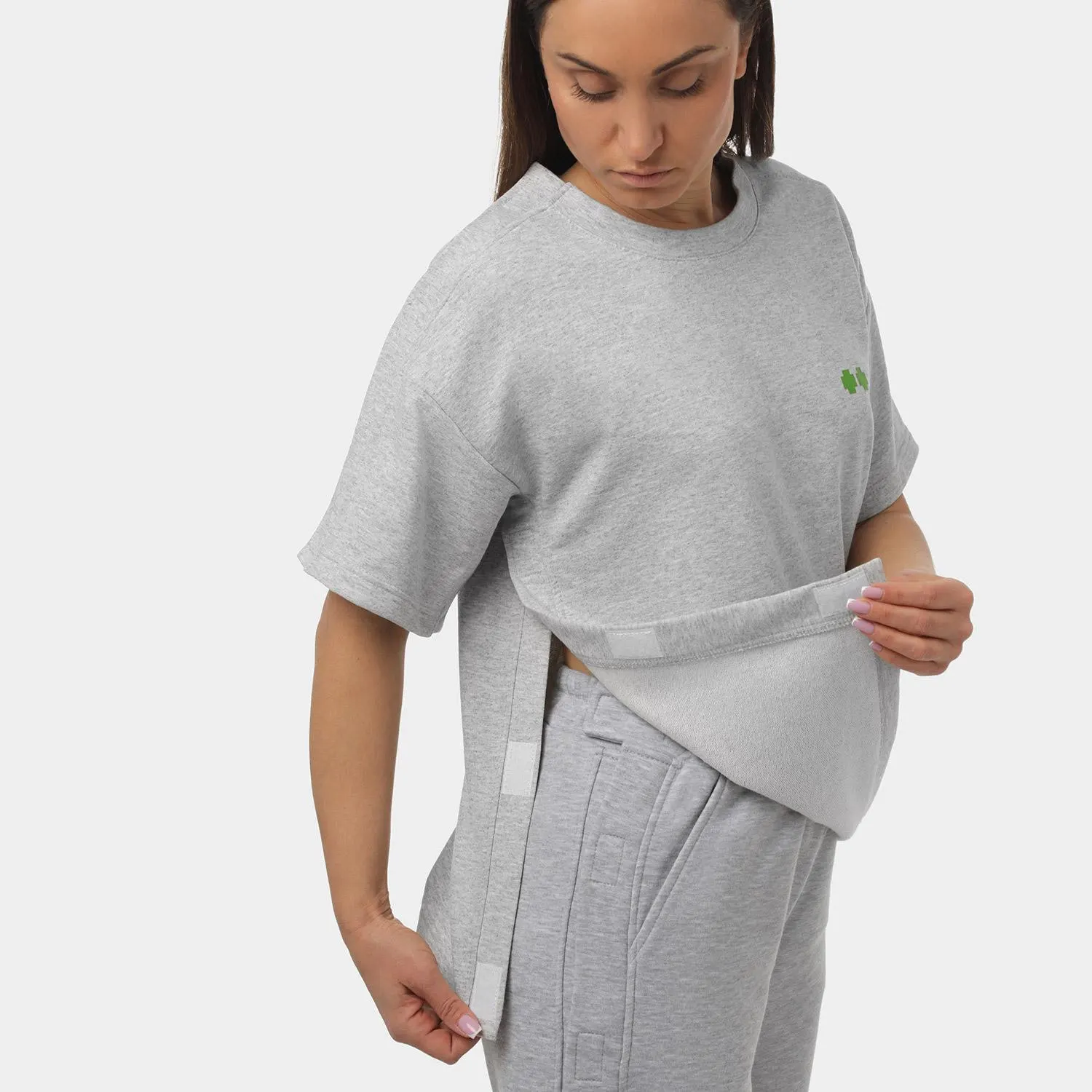
You’re back home after surgery, lying on the couch, feeling pretty decent… until it is time to change into a clean shirt. You reach for your favorite cotton t-shirt, start lifting your arm, and immediately hit a wall of sharp pain… Ouch!
Of course, nobody tells you before surgery that your regular clothes are about to become your temporary worst enemy. When you’re trying to pull a fitted shirt over fresh stitches and surgical drains that is a recipe for tears. Clinical statistics from the American College of Surgeons confirm that over 15 million Americans face post-surgical healing every year. To make matters more challenging, a study in the European Medical Journal documented that 81% of surgical patients deal with restricted arm mobility a full month after their procedure.
Undeniably, when your range of motion is temporarily dialed back to zero, standard necklines and tight sleeve cuffs simply do not work. As reported by Journal of Health, Wellness and Community Research, accidental pulling and post-op movement strain account for nearly 30% of early recovery complications and well, that’s where functional adaptive clothing steps in to save the day.
So, choosing a top tailored for post-surgery recovery protects your healing incisions while eliminating painful arm twisting and awkward overhead pulling. Built with ultra-soft fabrics and easy-open access, the right adaptive top restores your daily independence. It simplifies assisted dressing and brings real, effortless comfort back to your routine right when you need it most. If you are still confused about what to look for, don’t worry, read on as we explore exactly what makes a good post-surgery top for women and how to choose the right fit for your recovery!
Why Does Choosing the Right Top Matter After Surgery?
When you arrive home after surgery, your body is dealing with active inflammation, fresh surgical drains, and limited shoulder mobility. You might be eager to jump back into your normal morning routine, but early recovery completely changes what your body can do on an ordinary morning. Trying to squeeze everyday clothing over swollen surgical areas quickly turns morning dressing into an exhausting ordeal.
Arms that lifted freely last week may now stop dead at shoulder height and it is proven by a review of 32 studies reported by the UK’s National Institute for Health and Care Research, that up to 67% of women experience restricted shoulder movement after breast cancer treatment. That sudden physical limit does more than just hurt, in fact, it drains your emotional energy right when you need it most.
Here, the fundamental problem is that standard tops assume full joint mobility, which is the last thing you have while healing. When you force rigid, stiff fabrics over fresh stitches, you risk pulling delicate tissue and causing sudden pain spikes. On the contrary, choosing functional adaptive tops eliminates that overhead struggle entirely, giving you a smooth, gentle way to dress without risking your recovery.
Post Surgery Top vs. Traditional Top: What Should You Consider?
Are you still thinking about sticking with your regular wardrobe even after surgery and during post-recovery?
If yes, then comparing a post-surgery adaptive garment to a regular everyday shirt is essential as it’s not just about fabric softness… It comes down to functional design and daily ease. While standard clothes rely on full joint flexibility and overhead reaching, adaptive tops eliminate physical strain through smart access points. Here is a quick breakdown of how the two compare across essential recovery features:
| Feature | Post Surgery Adaptive Top | Traditional Everyday Top |
| Dressing Access | Open back or front closures for zero overhead reaching | Requires pulling overhead or tight sleeve pushing |
| Seam Placement | Smooth, flat seams positioned away from tender incisions | Standard raised seams that can rub against healing skin |
| Armhole Cut | Generous, relaxed arm openings for easy sleeve entry | Fitted armholes that require bending and lifting joints |
| Fabric Softness | Ultra-soft, breathable knits that minimize skin friction | Mixed fabrics that may feel stiff or hold moisture |
| Caregiver Ease | Allows fast, effortless dressing while seated or resting | Requires physical lifting and joint movement to change |
| Neckline Cut | Wide, flexible openings that prevent rubbing or pulling | Narrow collars that trap heat and catch on bandages |
| Incision Safety | Loose drape prevents friction over surgical drains or tape | Snug fits that press directly against sensitive spots |
| Closures | Larger snaps, zips, or easy fastenings | Small buttons or pullover necklines |
| Seated dressing | Made to go on while sitting | Often needs standing and twisting |
3 Comfort Factors to Look for in a Post Surgery Top
When you are recovering from surgery, physical comfort isn’t just a nice perk…
Don’t trust us then just imagine after surgery you turn your upper body to grab a glass of water, and your shirt immediately scratches across fresh stitches… Ouch! If you think that scenario is rare, nope… as regular cotton blends rub against incisions and surgical tape all day long, and the friction does more than annoy you, since it keeps irritating skin that’s already trying to heal.
Skin care shapes how smoothly recovery goes, too. Clinical research suggests post-operative nerve hypersensitivity affects around 30-50% of surgical patients, which turns coarse fabric into a daily source of discomfort.
So, the clothes you wear in those first weeks matter more than people expect and for that matter always opt for adaptive clothing. Adaptive tops are made for bodies that can’t lift or twist freely, and if you’re struggling to find one, then keep these three comfort features in mind:
- Soft Fabric: Smooth cotton blend or similar fabric will glide easily over stitches and sensitive healing areas instead of catching on them.
- Breathable Construction: A temperature-regulating material will allow the air to flow and prevent sweat from building up around sensitive incision areas, which will boost recovery.
- Relaxed Fit: Opt for a loose or a flowy silhouette as it doesn’t press on already inflamed or swollen areas, allowing your body to heal naturally.
How Should Post Surgery Top Fit During Recovery?
Anyone who has squeezed into a fitted top after surgery will tell you it’s a mistake they only make once. Snug fabric presses on healing tissue and adds weight right where it’s tender. Research suggests restrictive post-op clothing can raise localized swelling and slow lymphatic drainage by up to 25% in the early weeks, which is a lot to give up for a neat silhouette.
A good post surgery top should barely register on your body. Try it in the positions you’ll actually spend the day in, flat on your back or propped up in a recliner, because a top that feels fine in front of the mirror can behave very differently once you sit. These are the fit points worth checking.
- Room Through the Upper Body: Extra width across the torso lets the fabric float over dressings, so nothing digs in.
- Shoulder and Arm Mobility: Roomy armholes mean your arms go in without having to reach overhead at all.
- Seated Comfort: Added length at the back and soft side drapes keep you covered when you sit up straight in a chair.
- Changing Body Needs: Some give in the cut lets the top keep fitting as swelling settles from one week to the next.
Which Closure Styles Can Make Post Surgery Dressing Easier?
Undeniably… Closure style is easily the single most important functional detail of any recovery garment. Trying to align tiny metal buttons or reach a hidden back zipper requires joint flexibility you simply don’t have during early recovery. Whereas, easy-access fasteners allow you to dress effortlessly without raising your arms or straining tender chest muscles.
It isn’t just about convenience… The science behind adaptive clothing is simple: reduce physical leverage to protect healing tissue. Research highlighted by clinical mobility studies confirms that adaptive closure systems lower post-operative physical exertion by 30% during daily dressing activities. Gentle magnetic strips, flat snaps, and soft touch-fasteners allow tops to open up entirely flat.
By switching to functional adaptive closures, you protect your stitches and restore your morning independence. Having soft, easy-open garments in your wardrobe takes all the physical friction out of getting dressed each day.
When Is an Open Back Top Particularly Helpful After Surgery?
Say… you need to change your shirt, but your doctor strictly ordered zero overhead arm movement for the next three weeks. That is exactly where an open-back adaptive top saves the day as a total game-changer. Instead of forcing your arms through narrow sleeve holes, the garment slides on easily from the front while you stay completely comfortable.
This design shines brightest during early recovery when resting in bed or seated in an armchair. A family member or nurse can wrap the top around your front and overlap the back panels smoothly, eliminating any need for you to twist, lift, or strain, eliminating any movement that triggers sharp pain… doesn’t it sound like a dream.
Ask an occupational therapist about dressing after surgery and the first question that comes up is front-opening or open-back clothing? These styles take the tugging out of getting dressed with help and keep fabric away from tugging fresh incisions. The wearer also gets to feel like themselves instead of a patient being maneuvered into a shirt while preserving personal comfort and dignity.
4 Post Surgery Dressing Situations That Call for Different Clothing Needs
Finally, we are at a place where we need to address the “Dressing Reality & Wardrobe Longevity” especially for women who undergo top surgery.
Recovery rarely follows a straight line… and what feels easy during week three might have felt completely impossible on day three. As your mobility gradually returns, your daily clothing needs to shift right along with your body’s healing process. Matching your garments to your exact physical stage keeps you safe from accidental pulls or joint strain.
Which means post surgery dressing situations calls for different clothing needs… but fear not as here are the four most common recovery scenarios with the smart design features that are a must have:
- Restricted arm movement: Open-back and front-opening cuts remove the painful need to lift your arms above shoulder height.
- Dressing while seated: Full-back overlaps and flexible side seams make outfit changes smooth while sitting down comfortably.
- Assisted dressing support: Flat back-snap closures make changing fast, gentle, and stress-free for both you and your caregiver.
- Reclaiming your independence: Easy-touch fasteners let you dress on your own safely as your natural arm motion slowly returns.
How Can Women Choose a Top That Works Beyond the Early Recovery Period?
Nobody wants to fill their closet with expensive recovery wear that becomes completely useless after two short weeks. which is why the best adaptive garments are crafted with tasteful, modern cuts that look completely indistinguishable from standard boutique clothing. So to the eyes, nothing changes but for the women who have just undergone a surgery, it’s something that can’t be expressed.
By picking adaptive tops that have elegant styles and soft drape fabrics, you get clothes that transition naturally from early bedrest to casual lunches out.
Fabric resilience is another huge factor because clean hygiene requires frequent washings. Look for sturdy cotton-poly knits that maintain their elasticity, preserve rich color, and stay cozy through hot water cycles. When you buy smart, adaptive clothing isn’t just a medical necessity for early recovery… it becomes a permanent, comforting favorite in your daily rotation for years to come.
Explore Kayden Design’s Ladieswear Collection for Comfortable Adaptive Dressing!
If there’s one thing worth carrying away from all this, it’s that dressing shouldn’t get harder just because mobility does, and the right top can take real effort out of every morning. Of course, recovering from surgery should never mean compromising on your personal style or everyday dignity.
That is exactly why an experienced, dedicated brand matters. Kayden Design is a Canadian company based in Parksville, BC, and its ladieswear tops are made with limited mobility in mind. Prices run from $55.00 to $64.00, and the team will re-tailor a favourite top you already own instead of asking you to buy new… and that’s the best part. Plus, all pieces combine thoughtful functionality with stylish, modern aesthetics.
Their ladieswear tops feature buttery-soft, easily-washable fabrics that feel incredible against sensitive skin while offering complete ease for assisted or independent dressing:
- Generous snap overlaps preserve full modesty while eliminating overhead reaching.
- Durable, breathable materials that stay plush wash after wash.
- Beautiful colors and flattering cuts that doesn’t force you to give up on your style.
- Easy, hassle-free returns on all online orders
Take the strain out of your post-surgery recovery today. Explore the full ladieswear adaptive collection at Kayden Design to find soft, dignifying tops tailored specifically for your comfort needs!
Frequently Asked Questions (FAQs)
Q1. What should I buy for top surgery recovery?
Stick to loose, front-opening or open-back shirts made from super soft cotton. You want clothes you can slide into without lifting your hands over your head or pulling across your chest. In case you’re overwhelmed with online options, Kayden Design is a great brand that makes adaptive tops with thoughtful considerations and gentle back snaps that open up flat, keeping your bandages and drainage tubes completely safe while you change.
Q2. What is the best clothing for women to wear after surgery?
Look for garments with wide arm openings, flat interior seams, and flexible open-back access. These small details keep rough fabric from rubbing against raw skin and make sitting down to dress much easier. If you are struggling to find options that don’t look clinical, the ladieswear line at Kayden Design offers soft, stylish recovery tops that blend subtle adaptive functionality with modern fashion.
Q3. What are the best clothes to wear after back surgery?
Focus on roomy, lightweight tops that open up fully in the front or back so you never have to twist or bend your spinal column. Clothes with easy snap closures let family members help you change while you lie down or sit still. If you want full coverage without rigid pressure on your spine, opt for open-back tops that are designed specifically to glide smoothly during sensitive recovery periods.
Q4. What to wear after top surgery?
Go for loose, wide-cut tops that open up completely rather than anything you have to pull over your face. Having extra space across the chest leaves plenty of room for surgical compression wraps and drainage tubes without feeling restricted. If you’re trying to put together a stress-free recovery wardrobe, Kayden Design provides zero-reach adaptive tops that protect your healing incisions while keeping you comfortable all day.



